In 2020, the BNCCP was launched to provide strategic direction to achieve Brunei Darussalam’s Nationally Determined Contribution (NDC). It outlines 10 key strategies across addressing Mitigation, Adaptation, and Enablers to shape the country towards becoming a sustainable, low-carbon, and climate-resilient country.

The BNCCP is currently being updated to ensure that Brunei Darussalam’s climate policy framework remains relevant, realistic, and effective in addressing current and future climate challenges.
Reduce overall greenhouse gas emissions from the industrial sector through zero routine flaring and to As-Low-As-Reasonably-Practicable (ALARP).
Increase carbon sink through afforestation and reforestation with a target of planting 500,000 new trees.
Increase total share of electric vehicles to 60% of total annual vehicle sales.
Increase the total share of renewable energy to at least 30% of total capacity in the power generation mix.
Reduce greenhouse gas emissions by at least 10% through better supply and demand management of electricity consumption.
Impose price on carbon emissions.
Reduce municipal waste to landfills to 1kg/person/day.
To strengthen Brunei Darussalam’s resilience to climate change risks and increase its ability to reduce its vulnerability to the impacts of climate change.
To strengthen the national greenhouse gas inventory by monitoring all greenhouse gas emission and removal calculation activities, and ensuring that the national greenhouse gas inventory is transparent, complete, consistent, comparable, and accurate.
Increase awareness and education surrounding mitigation and adaptation responses against climate change.
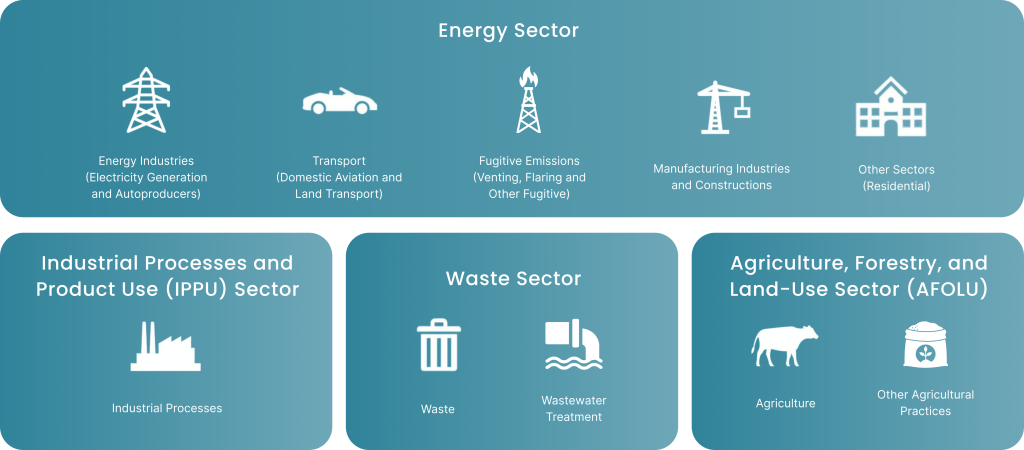
This involves government departments and private sector companies from 4 sectors:
Current Status
Protokol Hijau, launched in January 2021 is a guideline to reduce greenhouse gas emissions across public service premises in Brunei Darussalam: