CLIMATE CHANGE IN BRUNEI DARUSSALAM

What is Climate Change?

  • Climate change refers to the long-term changes in the Earth’s climate pattern, including changes in temperature, rainfall patterns, sea levels, and extreme weather events. These changes are primarily driven by the increased concentration of greenhouse gases in the atmosphere resulting from human activities.
  • According to the IPCC Sixth Assessment Report (2021), the planet has already warmed by approximately 1.09°C in 2011-2020 compared to 1850-1900. Under high greenhouse gas emissions scenarios, global temperatures could rise by around 2.4°C to 2.6°C by the end of the century.¹
  • ⁠The impacts of climate change are already being observed. 2024 was the warmest year on record, with the global average surface temperature approximately 1.55°C above pre-industrial levels. It was also the first calendar year in which the global average temperature exceeded 1.5°C above the pre-industrial average.²

Sources: ¹IPCC Sixth Assessment Report (2021) and ²World Meteorological Organization (2024)

Brunei Darussalam remains susceptible to rising temperatures and unpredictable rainfall.

Temperature

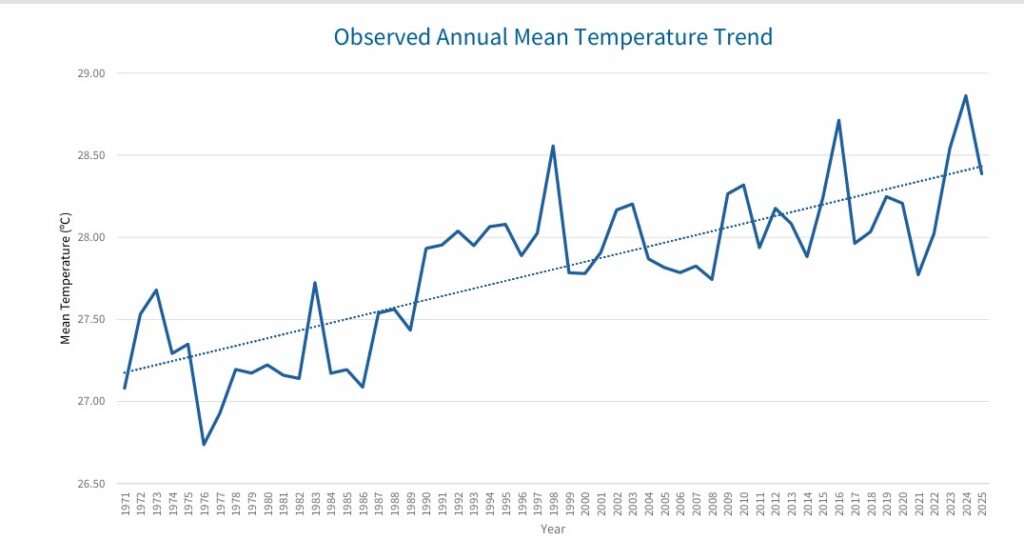
The annual mean temperature for Brunei Darussalam has increased by 0.23°C/decade (1971–2025).

The year 2024 was the warmest year on record for Brunei Darussalam, with an annual mean temperature of 28.9°C, which is 0.8°C above the long-term average of 28.1°C.


Rainfall

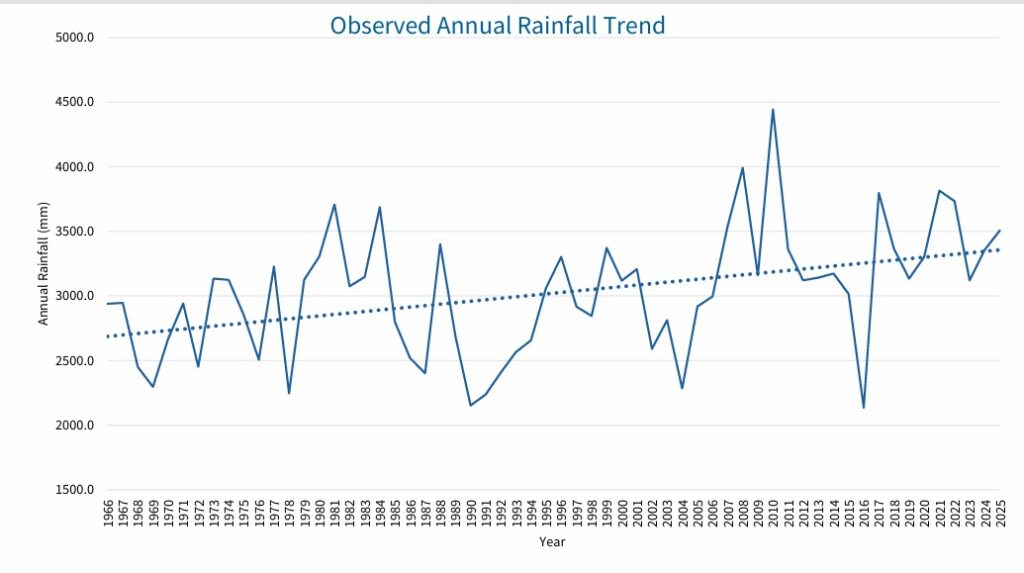
The annual rainfall trend for Brunei Darussalam has increased by 114 mm/decade (1966-2025).

Source: Brunei Darussalam Meteorological Department, Ministry of Transport and Infocommunications

Effects on Brunei Darussalam

Agriculture and Food Security

Brunei Darussalam strives to achieve food security through self-sufficiency for a number of commodities. With unpredictable rainfall patterns and rising temperatures, climate change is impacting the agriculture and agrifood industry.

Prolonged rainfall and flooding caused decline in crop production of $80.35 million with a 19% decrease in 2024. 

Biodiversity and Environment

Brunei Darussalam’s pristine tropical rainforests and peatlands are highly vulnerable to shifts in seasonal patterns. Extended dry periods driven by El Niño events significantly increase the frequency and severity of bush and forest fires, leading to devastating peatland degradation and dense haze.

In 2024, Brunei Darussalam recorded one of its warmest years on record, with an annual mean temperature of 28.9°C, coinciding with a higher-than-average number of forest fire incidents, totalling 913 cases. 

Health and Livelihood

Rising temperatures and prolonged warm spells present severe health risks such as heat stress, particularly for outdoor workers and students. Concurrently, shifting temperature and rainfall patterns expand the transmission windows for vector-borne diseases by accelerating vector breeding.

Dengue fever is the most prevalent vector-borne disease in the country, with transmission increasing at higher temperatures due to accelerated mosquito breeding. This was evident in 2015, when a record 316 cases coincided with an exceptionally warm annual average temperature of 28.4°C

Infrastructure and Urban Resilience

The country’s urban infrastructure faces an escalating threat from intensified rainfall and increased temperatures, which overwhelm structural drainage systems. This led to severe localised flash flooding and severe geohazards, such as landslides and slope failures, which damage road networks and fracture critical utilities.

Due to strong winds, fallen trees severed a main water pipeline in Batang Mitus, Tutong, on 29 January 2026. The incident affected 16 pipelines and triggered a major water disruption that lasted up to 8 days across the Brunei-Muara District. 

Marine Protection and Coastal Resilience

Rising sea surface temperatures create intense thermal stress, triggering coral bleaching events and endangering the rich marine ecosystem that sustains the local fisheries sector.

In 2024, coral cover at some monitoring sites in Brunei Darussalam was found to have decreased to 21% i.e., below the historical national average, highlighting the significant changes on the nation’s vital coral reef ecosystems that may have been impacted from climate change and ocean warming.

Sources: Department of Fisheries, Ministry of Economy, Trade and Industry

Water Resources

With unpredictable rainfall, Brunei Darussalam is vulnerable to flooding risks due to frequent and intense rainfall, while prolonged dry periods increase risks of drought and water stress. This places pressure on water-related infrastructure and fresh water availability to maintain water security.

The annual rainfall trend for Brunei Darussalam has increased by 114 mm/decade (1966-2025).